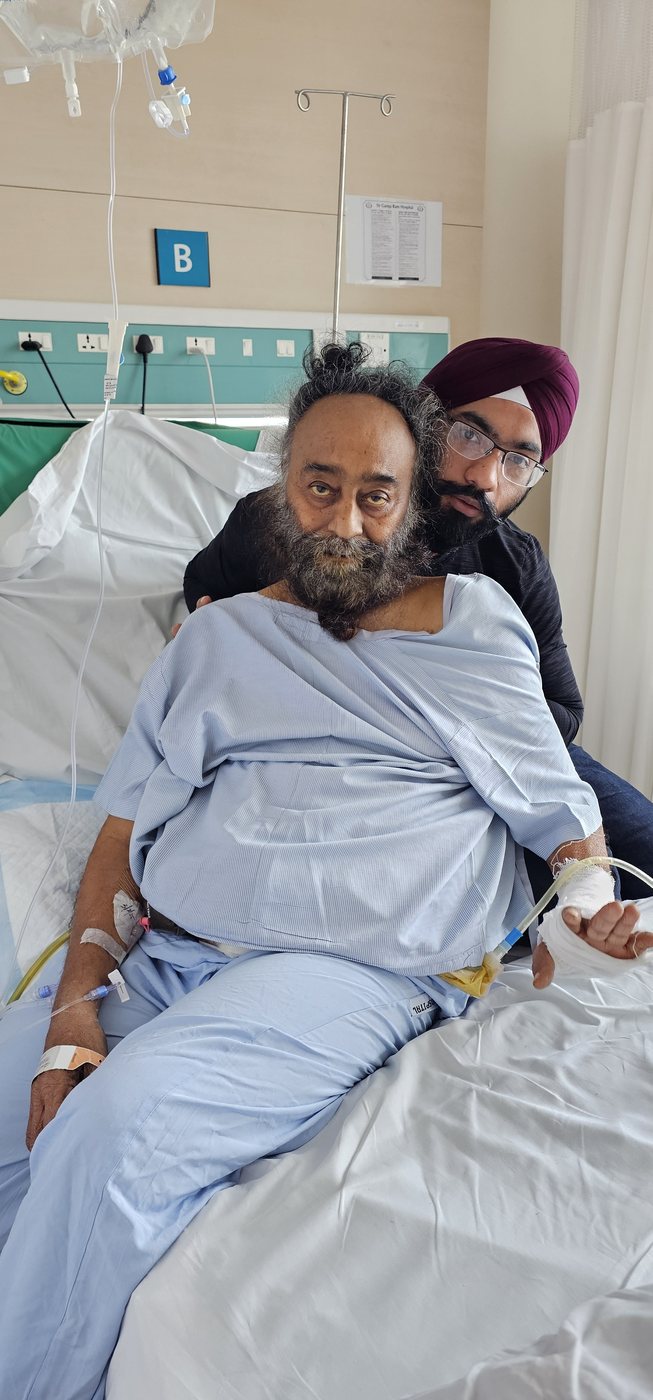
Gurdeep Singh Saluja
He walked in able to talk and to sign his own name. One hundred and eleven days later he was dead — operated on under a consent that named a smaller surgery, carrying a bowel injury that, according to the hospital's own notes, no one in my family was ever told about, and treated with an antibiotic the hospital's own lab had already proven would not work. This was a preventable death.
Read it for yourself
Nothing on this page asks you to take my word for it. The documents are the witness.
His story, in my words
The hospital's own paper
What was done to his body
Where it stands now
How it happened
Admitted
A stone blocking his bile duct. A stent is placed. The ordinary start of what should have been a routine recovery.
Their own lab finds a drug-resistant infection
A culture grows a carbapenem-resistant infection — recorded as resistant to Meropenem, sensitive to only one reserve drug. It is in their records. It is never cleared.
A far bigger operation than the one he signed for
The signed consent named a keyhole gallbladder removal. The operation actually performed, in the surgeon's own notes, was major open surgery — and during it, his bowel was torn and stitched.
The hidden injury surfaces
Emergency re-operation. Its notes refer to a "previously repaired" bowel tear — the first written trace of an injury we were never told about. The repair had failed. His bowel had burst inside him.
Discharged at 11:04 pm, re-admitted 77 minutes later
One signed page says he needs 3–5 more days of care and that he is "stable." Minutes later he is taken back in under a brand-new file as a "charity" patient. He never really left.
He died
Sepsis. Organ failure. The death summary — written sixteen days later by the same doctors — leaves out the bowel injury and how the infection ever took hold.
The facts they wrote down
Every point below comes from the hospital's own paperwork. The criminal complaint rests on these.
An injury caused, repaired, and erased
The 9 January surgery notes mention no bowel tear. The 12 January re-operation notes call it a "previously repaired" tear. The injury was real. The silence about it was a choice.
He consented to one operation. They did another.
The form names "Laparoscopic Cholecystectomy." What was done was open surgery with bowel handling and bile-duct exploration — the step in which his bowel was torn.
A drug they knew would not work
After the emergency re-operation, the antibiotic given was the very one their own culture had already marked ineffective against his infection.
"Needs 3–5 more days" and "stable" — same page
One signed document says both. He was re-admitted 77 minutes later under a new file number. The complaint says this was about money and liability, not his health.
Over ₹32 lakh — on documents we dispute
Bills past ₹32 lakh were raised; around ₹27 lakh paid from our own pockets — resting, the complaint alleges, on consent forms that were blank, disputed, or signed for procedures never named.
The case
Make it impossible to ignore
The most powerful thing you can do is make this travel. Share it. Tag journalists and creators who cover health and accountability. Silence is what they are counting on.